
♨️ Bromine Spa Calculator
Calculate bromine dosing, bromine shock, bromine bank activation & complete bromine spa treatment plans
⚠️ Bromine Spa Safety Note
BROMINE IS MORE STABLE THAN CHLORINE IN HOT WATER. Bromine remains effective at higher temperatures and pH levels where chlorine breaks down. Ideal bromine level for spas is 3-5 ppm. Bromine tablets (BCDMH) dissolve slowly and provide continuous sanitization — place them in a floating dispenser or inline feeder. Do NOT add bromine tablets directly to the spa — they sink and can damage the surface. Bromine shock (MPS) activates the bromide bank to produce active bromine. Never mix bromine with chlorine products. Wear gloves when handling bromine granular. Keep bromine products away from children and pets. Do not enter spa until bromine level is 3-5 ppm.
Calculation History
💡 You Might Also Like
Bromine Spa Calculator: Bromine Dosing, Bromine Shock, Bromine Bank Activation & Complete Bromine Spa Plans
A bromine spa calculator is an essential tool that helps spa and hot tub owners accurately calculate bromine dosing (BCDMH tablets, sodium bromide granular, liquid bromine), bromine shock amounts (MPS non-chlorine shock, dichlor, or 2-part bromine shock), bromine bank activation (building the bromide reserve that MPS activates), and complete bromine spa treatment plans with all parameters assessed. Bromine is the preferred sanitizer for hot tubs because it remains effective at high temperatures (up to 104°F) and higher pH levels (up to 8.0) where chlorine breaks down. Whether you’re dosing BCDMH tablets for daily sanitization, shocking with MPS to activate the bromine bank, building a bromide bank from scratch with sodium bromide, or getting a complete bromine spa action plan, this bromine spa calculator provides precise calculations with step-by-step explanations for safe and effective bromine spa maintenance.
BROMINE IS MORE STABLE THAN CHLORINE IN HOT WATER. Bromine remains effective at temperatures up to 104°F and pH levels up to 8.0 where chlorine becomes ineffective. Ideal bromine level for spas is 3-5 ppm. BCDMH tablets dissolve slowly and provide continuous sanitization — place them in a floating dispenser or inline feeder, NEVER directly in the spa (they sink and damage surfaces). Bromine shock (MPS) activates the bromide bank to produce active bromine — no chlorine is added. Never mix bromine with chlorine products — they react unpredictably. Wear gloves when handling bromine granular. Keep bromine products away from children and pets. Do not enter spa until bromine level is 3-5 ppm. If bromine exceeds 10 ppm, wait for it to dissipate or partially drain and refill.
📋 Table of Contents
▼What a Bromine Spa Calculator Does
A bromine spa calculator is a specialized tool that performs essential calculations for bromine-based spa sanitization, including calculating BCDMH tablet dosing (65% and 92% concentrations), sodium bromide granular dosing (for bromine bank building), liquid bromine dosing (fast-acting BCDMH solution), bromine shock amounts (MPS non-chlorine shock, dichlor, or 2-part bromine shock), bromine bank activation (building the bromide reserve that MPS activates to produce active bromine), and complete bromine spa treatment plans with all parameters assessed. According to the Centers for Disease Control and Prevention (CDC), bromine is the preferred sanitizer for hot tubs and spas because it remains effective at high temperatures and pH levels where chlorine becomes ineffective.
A bromine spa calculator tells you exactly how many BCDMH tablets to place in your floating dispenser for a 400-gallon spa, how much sodium bromide to add to build a bromide bank from scratch, how much MPS to shock with to activate the bromine bank, and the complete bromine spa action plan with pH, alkalinity, and temperature assessment. Unlike chlorine calculators that work with chlorine-specific products, a bromine spa calculator understands the unique bromine system: BCDMH tablets that dissolve slowly and continuously, the bromide bank that stores inactive bromide ions, and MPS shock that activates the bank to produce active bromine on demand. Every bromine spa owner, hot tub technician, and resort maintenance staff relies on these calculations, and the bromine spa calculator exists to make them fast, accurate, and educational.
The reason bromine spa calculations trip people up is the bromine bank concept. Unlike chlorine, which is added directly and works immediately, bromine works through a two-step system: the bromide bank stores inactive bromide ions, and MPS shock activates the bank to produce active bromine. Many spa owners don’t understand this system and either over-dose BCDMH tablets (thinking they need to “dose” like chlorine) or under-shock with MPS (not activating the bank enough). The bromine spa calculator handles the bromine bank system internally, providing clear dosing for each step.
This bromine spa calculator handles the four most important bromine spa tasks in one place: bromine dosing (BCDMH tablets, sodium bromide, liquid bromine, high-concentration tablets), bromine shock (MPS, dichlor, 2-part shock), bromine bank activation (building the bromide reserve from scratch or maintaining it), and complete bromine spa plans (evaluating bromine, pH, TA, and temperature with prioritized action recommendations). Each mode shows the answer and every step of the working, so you can verify the reasoning, learn the bromine system, or document the calculation for your spa maintenance records.
Whether you are a new bromine spa owner learning the bromine bank system, an experienced hot tub owner fine-tuning your bromine dosing, a spa service technician managing multiple client bromine spas, or a resort maintenance staff keeping guest bromine spas sanitized, the bromine spa calculator gives you the exact calculations every time—no guesswork, no over-dosing, no under-activated bromine bank, no ineffective sanitization.

How Bromine Spa Calculations Work
Every bromine spa calculation comes down to one core concept: the bromine bank system. Unlike chlorine, which is added directly and works immediately, bromine works through a two-step system: the bromide bank stores inactive bromide ions, and an oxidizer (MPS or chlorine) activates the bank to produce active bromine. From that concept, a handful of formulas cover almost every bromine spa task. The bromine spa calculator exists to handle these formulas reliably and transparently.
Bromine Dosing: BCDMH Tablets and Liquid Bromine
BCDMH tablets (65% or 92% concentration) dissolve slowly in a floating dispenser or inline feeder, providing continuous bromine release over 24-48 hours. The bromine spa calculator uses product-specific dosing rates: BCDMH 65% tablets require approximately 0.15 oz per 100 gallons per 1 ppm increase; BCDMH 92% tablets require approximately 0.11 oz per 100 gallons per 1 ppm increase; Liquid bromine (BCDMH solution) requires approximately 0.50 fl oz per 100 gallons per 1 ppm increase. For a 400-gallon spa going from 1 to 4 ppm with 65% tablets: (400 / 100) × 3 × 0.15 = 1.8 oz (about 3.6 tablets at 0.5 oz each). Place tablets in a floating dispenser — never add directly to the spa.
increase = desired bromine increase in ppm
rate = product-specific rate per 100 gal per 1 ppm
BCDMH 65%: 0.15 oz | BCDMH 92%: 0.11 oz | Liquid: 0.50 fl oz
Bromine Shock: MPS and 2-Part Shock
Bromine shock activates the bromide bank to produce active bromine and oxidizes contaminants. The bromine spa calculator uses three shock methods: MPS (non-chlorine shock) requires approximately 0.5 oz per 100 gallons (activates bromide bank without adding chlorine); Dichlor 56% (chlorine shock) requires approximately 0.36 oz per 100 gallons per 1 ppm increase (also activates bromide bank); 2-part bromine shock (sodium bromide + MPS) requires approximately 0.7 oz total per 100 gallons (0.2 oz bromide + 0.5 oz MPS — most effective bromine shock method). For a 400-gallon spa weekly shock with MPS: (400 / 100) × 0.5 = 2.0 oz.
Bromine Bank: Building the Bromide Reserve
The bromine bank is the reserve of inactive bromide ions stored in the water. When MPS or chlorine is added, it activates the bromide bank to produce active bromine. A new bromine spa starts with 0 ppm bromide — you must build the bank before bromine will work. The bromine spa calculator uses: Sodium bromide (NaBr) requires approximately 0.67 oz per 100 gallons per 10 ppm bromide increase. For a 400-gallon spa building a 30 ppm bromide bank from 0: (400 / 100) × (30 / 10) × 0.67 = 8.04 oz of sodium bromide. After adding sodium bromide, shock with MPS to activate the bank and produce 3-5 ppm active bromine.
Bromine vs. Chlorine: Why Bromine for Spas
Bromine is superior to chlorine for hot tubs for three reasons: 1) Bromine remains effective at temperatures up to 104°F where chlorine breaks down rapidly; 2) Bromine remains effective at pH levels up to 8.0 where chlorine becomes ineffective above 7.8; 3) Bromine produces less odor and is less irritating to skin and eyes than chlorine at spa temperatures. The trade-off is that bromine is more expensive and requires the bromine bank system, which is more complex than direct chlorine dosing. The bromine spa calculator handles this complexity, making bromine spa management as easy as chlorine.
Quick Reference Values for the Bromine Spa Calculator
Remember: The bromine spa calculator provides accurate dosing for the bromine bank system, but BCDMH tablets dissolve slowly over 24-48 hours. Place tablets in a floating dispenser or inline feeder — never add directly to the spa. For bromine shock, wait 24 hours after shocking before using the spa. Retest bromine — should be 3-5 ppm before use.

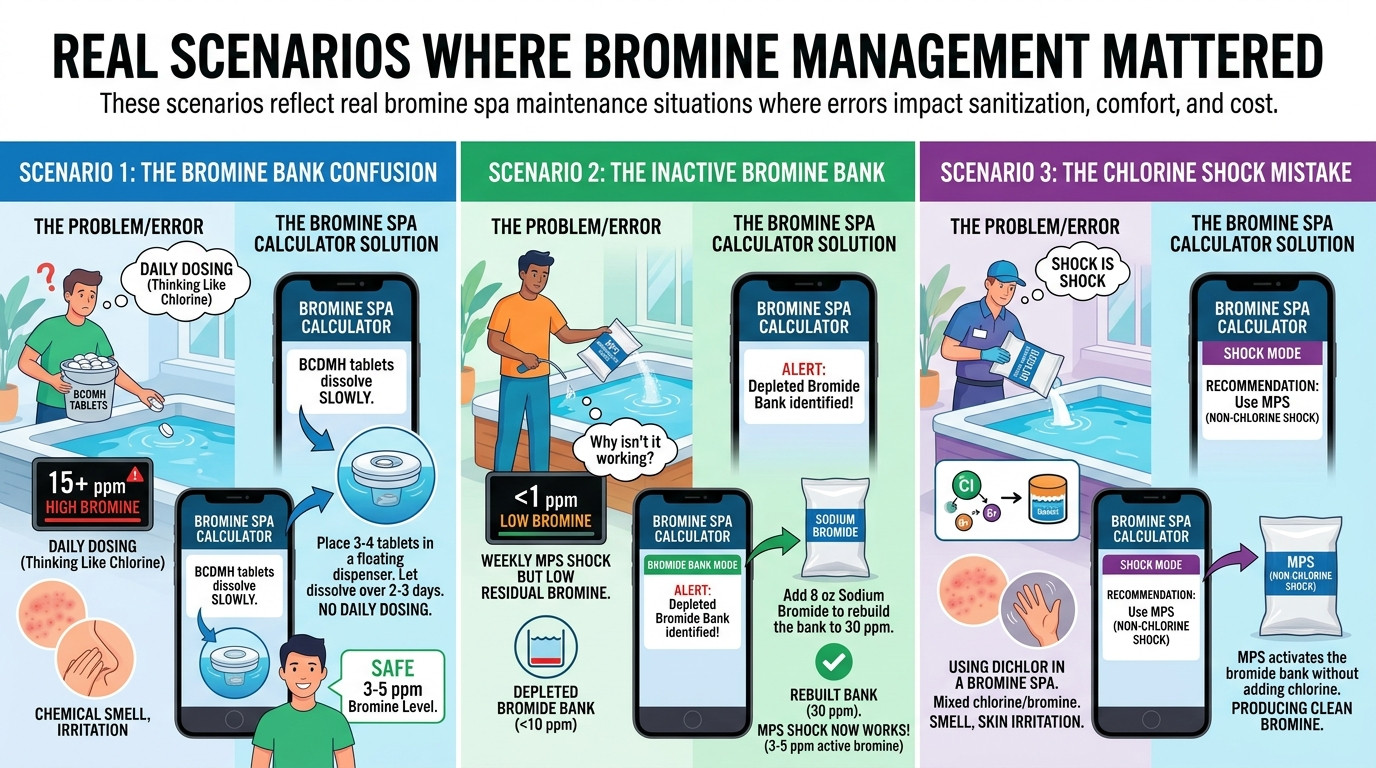
Real Scenarios Where Bromine Management Mattered
These scenarios reflect real bromine spa maintenance situations where bromine management errors made a tangible difference to sanitization effectiveness, bather comfort, and cost. Each scenario shows how the bromine spa calculator would have prevented the error.
Scenario 1: The Bromine Bank Confusion
A new bromine spa owner added BCDMH tablets daily, thinking they needed to “dose” like chlorine. After a week, bromine levels were 15+ ppm — far above the safe 5 ppm maximum. The spa had a strong chemical smell and caused skin irritation. The bromine spa calculator would have explained that BCDMH tablets dissolve slowly and continuously — place 3-4 tablets in the floating dispenser and let them dissolve over 2-3 days. No daily dosing needed. This would have prevented the 3× overdose and the skin irritation.
Scenario 2: The Inactive Bromine Bank
A bromine spa owner shocked with MPS weekly but bromine levels never stayed above 1 ppm. The problem: the bromide bank was depleted (below 10 ppm). MPS activates the bromide bank to produce bromine, but if the bank is empty, there’s nothing to activate. The bromine spa calculator’s bromine bank mode would have identified the depleted bank and recommended adding 8 oz of sodium bromide to rebuild the bank to 30 ppm — then MPS shock would produce 3-5 ppm active bromine consistently.
Scenario 3: The Chlorine Shock Mistake
A spa service tech used dichlor (chlorine shock) on a bromine spa, thinking “shock is shock.” The chlorine reacted with the bromide bank to produce bromine, but also added chlorine to the water. The mixed chlorine/bromine caused a strong chemical smell and skin irritation. The bromine spa calculator’s shock mode would have recommended MPS (non-chlorine shock) for bromine spas — it activates the bromide bank without adding chlorine, producing clean bromine without the chlorine side effects.
Scenario 4: The Tablet Placement Disaster
A bromine spa owner added BCDMH tablets directly to the spa water instead of placing them in a floating dispenser. The tablets sank to the bottom and dissolved in concentrated spots, bleaching the spa surface and causing permanent damage ($2,000 repair). The bromine spa calculator’s dosing mode includes the instruction: “Place tablets in floating dispenser or inline feeder. NEVER add directly to spa.” This would have prevented the $2,000 surface damage.
Common Bromine Spa Mistakes
These are the most frequent bromine spa errors that the bromine spa calculator helps prevent:
1. Dosing BCDMH Tablets Like Chlorine
BCDMH tablets dissolve slowly and continuously over 24-48 hours. They are NOT a daily dose like dichlor. Place 3-4 tablets in a floating dispenser and let them dissolve over 2-3 days. Replace when dissolved. The bromine spa calculator explains this for every tablet dosing calculation.
2. Adding Tablets Directly to the Spa
BCDMH tablets sink and dissolve in concentrated spots, bleaching and damaging the spa surface. Always place tablets in a floating dispenser or inline feeder. The bromine spa calculator includes this warning with every tablet dosing.
3. Not Building the Bromine Bank
A new bromine spa starts with 0 ppm bromide. You must build the bromide bank before bromine will work. Add sodium bromide to build the bank to 25-35 ppm, then shock with MPS to activate. The bromine spa calculator’s bank mode guides you through building the bank from scratch.
4. Using Chlorine Shock on Bromine Spas
Chlorine shock (dichlor) activates the bromide bank but also adds chlorine to the water, causing mixed chlorine/bromine with strong odor and skin irritation. Use MPS (non-chlorine shock) for bromine spas — it activates the bank without adding chlorine. The bromine spa calculator recommends MPS for all bromine spa shocking.
5. Under-Shocking the Bromine Bank
MPS activates the bromide bank to produce active bromine. If you under-dose MPS, the bank isn’t fully activated and bromine levels stay low. The bromine spa calculator’s shock mode calculates the correct MPS dose for weekly maintenance, heavy use, cloudy water, or contamination.
Warning: Bromine is more expensive than chlorine, but it lasts longer in hot water. A bromine spa typically uses 30-50% less chemical per month than a chlorine spa because bromine is more stable at high temperatures. The bromine spa calculator helps you dose precisely — no waste, no over-dosing, no ineffective sanitization.
Expert Perspectives on Bromine Spas
“Bromine is the only sanitizer I recommend for hot tubs. Chlorine breaks down at 100°F+ and becomes ineffective above pH 7.8. Bromine stays effective up to 104°F and pH 8.0. The bromine bank system is more complex than chlorine, but the bromine spa calculator makes it simple — it’s the first tool I give every new bromine spa owner.”
“The number one bromine spa problem I see is an inactive bromide bank. Owners shock with MPS but bromine stays low because the bank is depleted. The bromine spa calculator’s bank mode identifies this immediately and recommends rebuilding the bank with sodium bromide. It’s saved my clients thousands in wasted chemicals.”
“For resort bromine spas, consistency is everything. Guests expect perfect water every time. The bromine spa calculator helps our maintenance staff dose BCDMH tablets precisely, shock with MPS at the right intervals, and maintain the bromide bank — all without guesswork. We’ve reduced chemical costs by 25% and eliminated guest complaints about bromine smell.”
Expert Consensus: All three experts agree that bromine is the superior sanitizer for hot tubs, and the bromine bank system — while more complex than chlorine — is easily managed with the bromine spa calculator. Proper tablet dosing, regular MPS shocking, and bromide bank maintenance are the keys to effective bromine spa sanitization.
Frequently Asked Questions
BCDMH tablets dissolve slowly over 24-48 hours, so bromine levels build gradually. For liquid bromine and MPS shock, the response is faster (15-30 minutes). Always retest 30 minutes after shock before using the spa.
Place tablets in a floating dispenser or inline feeder — never add directly to the spa. Tablets dissolve over 24-48 hours. Replace when dissolved. The bromine spa calculator provides exact amounts for any spa volume and any target bromine increase.
A new bromine spa starts with 0 ppm bromide. You must build the bank by adding sodium bromide (NaBr) to reach 25-35 ppm bromide. Then shock with MPS to activate the bank and produce 3-5 ppm active bromine. The bromine spa calculator’s bank mode guides you through building the bank from scratch.
The trade-off is that bromine is more expensive and requires the bromine bank system. But for hot tubs, the advantages far outweigh the costs. The bromine spa calculator makes bromine management as easy as chlorine.
Use MPS (non-chlorine shock) for bromine spas — it activates the bromide bank without adding chlorine, producing clean bromine without chlorine side effects. The bromine spa calculator recommends MPS for all bromine spa shocking.
The bromine spa calculator’s shock mode calculates the correct MPS dose for weekly maintenance, heavy use, cloudy water, or contamination. For a 400-gallon spa, weekly MPS shock is approximately 2.0 oz.
Rebuild the bromide bank by adding sodium bromide (NaBr) to reach 25-35 ppm bromide. The bromine spa calculator’s bank mode calculates the exact amount needed. After rebuilding, MPS shock will produce 3-5 ppm active bromine consistently.
The bromine spa calculator includes this warning with every tablet dosing calculation. Tablets dissolve slowly over 24-48 hours in a dispenser — never add them directly to the spa water.
Rebuild the bank with sodium bromide. The bromine spa calculator’s bank mode calculates the exact amount needed to rebuild to 25-35 ppm. After rebuilding, MPS shock will produce consistent 3-5 ppm bromine.
The calculator provides the same accurate dosing regardless of spa material. For inflatable spas, use the same dosing rates — just ensure the spa is fully inflated and at operating temperature before adding chemicals.
Bromine Spa Best Practices
These practices separate effective bromine spa sanitization from ineffective bromine, depleted banks, and surface damage. Follow them alongside the bromine spa calculator for optimal results.
Before Adding Bromine
During Bromine Addition
After Bromine Addition
Trusted Reference Resources
These are authoritative references for bromine spa chemistry and hot tub sanitization that complement the bromine spa calculator.
CDC Healthy Swimming — Hot Tubs — cdc.gov/healthywater/swimming — CDC guidelines for hot tub sanitization, bromine levels, and recreational water illness prevention in bromine spas.
Pool & Hot Tub Alliance (PHTA) — phta.org — Industry association for spa professionals, offering education, certification, and best practices for bromine spa management and sanitization.
National Swimming Pool Foundation (NSPF) — nspf.org — Certified Pool/Spa Operator (CPO) training, bromine chemistry education, and hot tub sanitization guidelines.
Bromine Chemistry Council — bromine.org — Industry organization for bromine chemistry, offering technical information on BCDMH, bromine bank systems, and bromine spa sanitization.
On our platform, related calculation tools that complement the bromine spa calculator include: spa chemical calculator, pool chemistry calculator, pool alkalinity calculator, pool calcium hardness calculator, cyanuric acid calculator, pool volume calculator, pH calculator, PPM calculator, solution dilution calculator, percent concentration calculator, dilution factor calculator, and dilution calculator (all-in-one).
Leave a Review
Used this bromine spa calculator for your hot tub maintenance? Share your experience below. Your review helps other bromine spa owners decide if this bromine spa calculator fits their maintenance needs. Every review is stored locally on your device and appears instantly.
📝 Share Your Experience
Final Thoughts on the Bromine Spa Calculator
Bromine is the superior sanitizer for hot tubs — and the bromine spa calculator exists to make bromine management simple. Bromine remains effective at temperatures up to 104°F and pH levels up to 8.0 where chlorine breaks down rapidly. The bromine bank system — while more complex than direct chlorine dosing — is easily managed with the bromine spa calculator: BCDMH tablets dissolve slowly in a floating dispenser, MPS shock activates the bromide bank weekly, and sodium bromide rebuilds the bank when depleted. At 3-5 ppm active bromine, your spa water is safe, comfortable, and fully sanitized — even at 104°F.
What separates effective bromine spa sanitization from ineffective bromine and depleted banks is understanding the bromine bank system. Using the bromine spa calculator for precise BCDMH tablet dosing, regular MPS shocking, bromide bank maintenance, and never adding tablets directly to the spa: these are the habits that prevent over-dosing, under-activated banks, and surface damage. The bromine spa calculator does the math perfectly every time, but it cannot place the tablets in the dispenser or shock with MPS — those remain the spa owner’s responsibilities.
The framework is short: test bromine 2-3 times per week, calculate with the bromine spa calculator, place BCDMH tablets in floating dispenser, shock with MPS weekly, rebuild bromide bank when depleted, and use the spa only when bromine is 3-5 ppm. That sequence gives safe, comfortable, fully sanitized bromine spa water every time. From residential bromine spas and resort hot tubs to commercial therapy spas, accurate bromine calculations are the foundation of effective hot tub sanitization, and getting it right with the bromine spa calculator is the most important skill in bromine spa maintenance.
Keep this bromine spa calculator handy as your starting point for every bromine spa task, and use the related dilution and concentration tools in the sidebar whenever you need to plan or verify a calculation before treating your bromine spa.
🔒 Privacy Guarantee: Every calculation on this bromine spa calculator page runs entirely within your browser. No data—spa volumes, bromine levels, bromide bank levels, or any other inputs—is sent to any server, stored, or shared. Your calculations are completely private.