
🍺 Brewing Calculator
Calculate ABV, gravity conversions, IBU bitterness & carbonation for perfect homebrew
🔬 Brewing Science Note
This brewing calculator uses established formulas (Tinseth for IBU, standard ABV calculations) to provide accurate estimates. Actual results may vary based on yeast strain, fermentation temperature, hop freshness, and other factors. Always verify with hydrometer readings and taste tests.
Calculation History
💡 You Might Also Like
Brewing Calculator: ABV, Gravity, IBU & Carbonation Calculator for Homebrewers
A brewing calculator is an essential tool that helps homebrewers and craft brewers accurately calculate alcohol by volume (ABV), convert between gravity measurement scales (specific gravity, Plato, Brix), determine bitterness levels in International Bitterness Units (IBU), and calculate precise carbonation levels for bottle conditioning or force carbonation. Using established brewing science formulas like the standard ABV equation (OG – FG) × 131.25 and the Tinseth IBU formula, this brewing calculator ensures consistent, high-quality beer with predictable flavor profiles and proper carbonation every time you brew.
THIS CALCULATOR PROVIDES ESTIMATES BASED ON ESTABLISHED FORMULAS. Actual results may vary based on yeast strain, fermentation temperature, hop freshness, water chemistry, and other brewing variables. Always verify calculations with hydrometer or refractometer readings. For bottle conditioning, never exceed recommended priming sugar amounts to avoid bottle bombs. Force carbonation requires proper keg equipment and pressure relief valves. This brewing calculator is a planning tool—always taste, measure, and adjust based on your specific brewing conditions and equipment.
📋 Table of Contents
▼What a Brewing Calculator Does
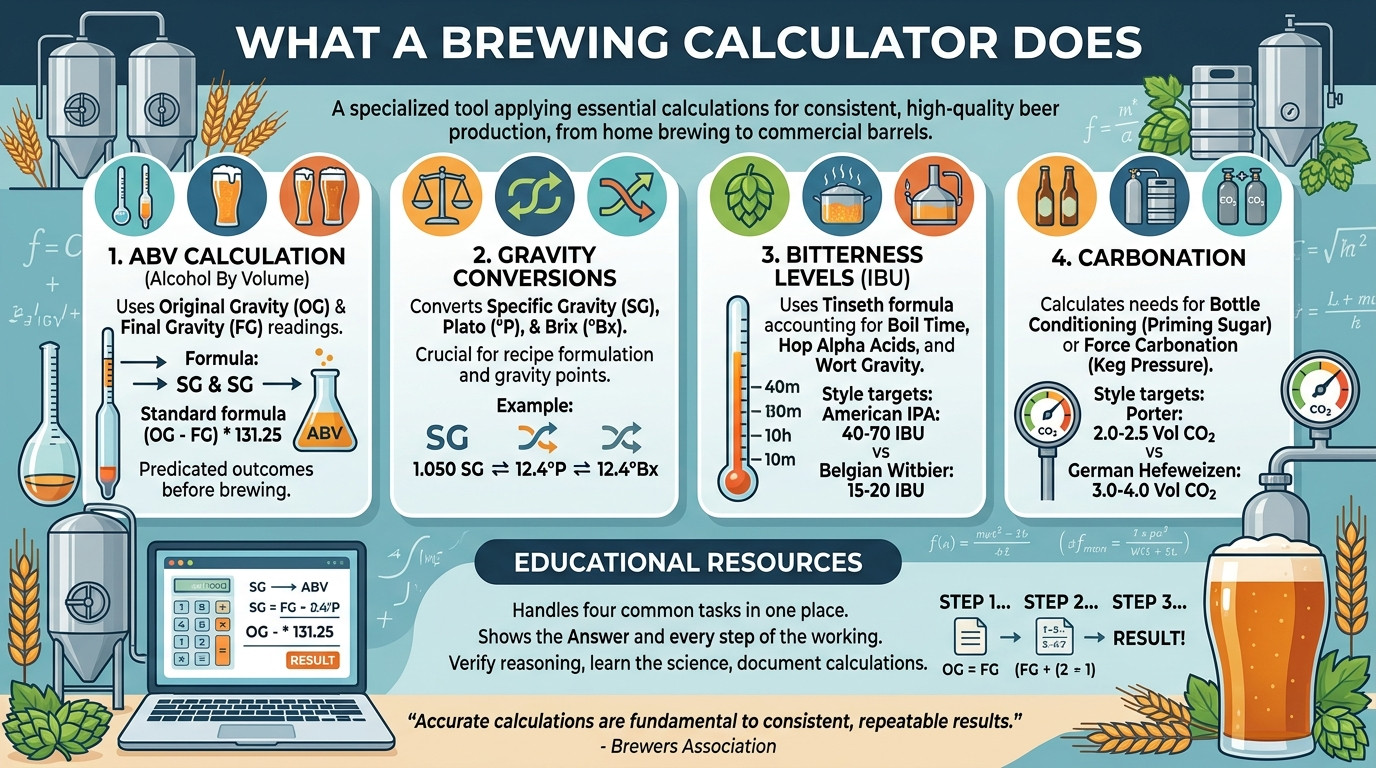
A brewing calculator is a specialized tool that performs essential calculations for beer brewing, including alcohol by volume (ABV) from original and final gravity readings, gravity conversions between specific gravity (SG), Plato (°P), and Brix (°Bx) scales, bitterness levels in International Bitterness Units (IBU) using the Tinseth formula, and carbonation levels for bottle conditioning or force carbonation. According to the Brewers Association, accurate calculations are fundamental to consistent, high-quality beer production—whether you’re brewing 5 gallons at home or 50 barrels commercially.
A brewing calculator tells you exactly what to expect from your brew before you even start. Unlike trial-and-error brewing, a brewing calculator uses established brewing science formulas to predict outcomes: ABV from gravity readings, bitterness from hop additions, and carbonation from priming sugar or CO2 pressure. Every homebrewer, craft brewer, and brewing student who wants consistent, repeatable results relies on these calculations daily, and the brewing calculator exists to make them fast, accurate, and educational.
The reason brewing calculations trip people up is not the arithmetic itself but the multiple measurement systems, the temperature corrections, and the style-specific targets. An American IPA needs 40-70 IBU for proper bitterness, but a Belgian witbier needs only 15-20 IBU. A porter should have 2.0-2.5 volumes of CO2, but a German hefeweizen needs 3.0-4.0 volumes for proper mouthfeel. A brewer needs to know that 1.050 SG equals 12.4°P equals 12.4°Bx. The brewing calculator handles all of these conversions and calculations internally so you can focus on brewing great beer rather than doing complex math.
This brewing calculator handles the four most common brewing calculation tasks in one place: ABV calculation from original and final gravity (using the standard formula), gravity conversions between SG, Plato, and Brix scales (including gravity points for recipe formulation), IBU calculation using the Tinseth formula (accounting for boil time, hop alpha acids, and wort gravity), and carbonation calculation for both bottle conditioning (priming sugar) and force carbonation (keg pressure). Each mode shows the answer and every step of the working, so you can verify the reasoning, learn the science, or document the calculation for your brewing records.
Whether you are a homebrewer formulating your first recipe, a craft brewer scaling up from pilot to production batches, a brewing student learning the science behind beer, or a competition brewer fine-tuning recipes for BJCP style guidelines, the brewing calculator gives you the exact calculations every time—no guesswork, no inconsistent batches, no failed experiments.
How Brewing Calculations Work
Every brewing calculation comes down to one idea: beer is a product of chemistry, biology, and physics, and understanding the math behind these sciences allows you to predict and control the brewing process. From that single principle, a handful of formulas cover almost every brewing calculation task. The brewing calculator exists to handle those formulas reliably and transparently, because in practice the “arithmetic” is layered with temperature corrections, unit conversions, and style-specific targets—and any one of them, applied wrongly, can produce a beer that misses the mark.
Understanding ABV (Alcohol by Volume)
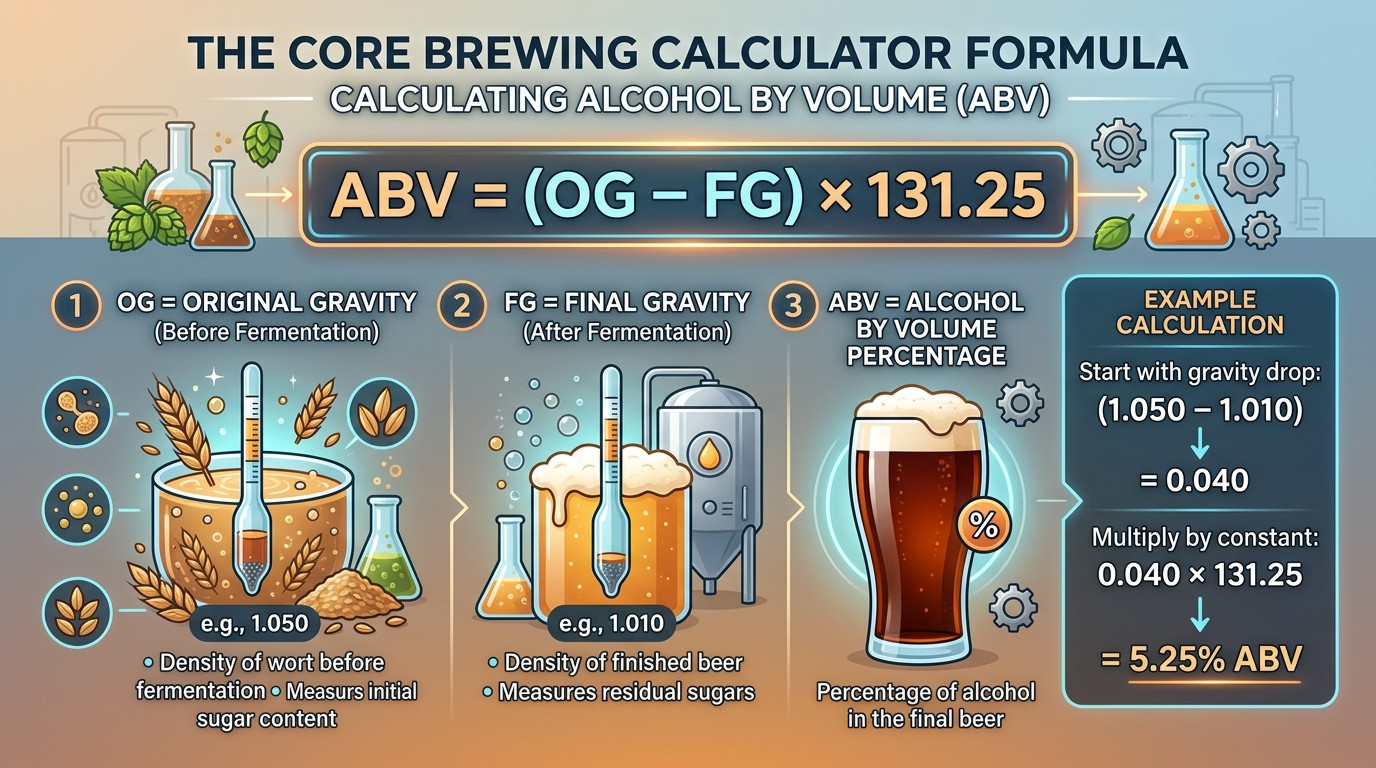
ABV is the standard measurement of alcohol content in beer, expressed as a percentage of the total volume. During fermentation, yeast converts sugars into alcohol and CO2, reducing the density of the wort. By measuring the original gravity (OG) before fermentation and the final gravity (FG) after fermentation, you can calculate how much alcohol was produced. The brewing calculator uses the standard ABV formula: ABV = (OG – FG) × 131.25, which provides accurate results for most beer styles. For high-gravity beers (OG > 1.080), an alternative formula provides more accurate results.
FG = Final Gravity (after fermentation, e.g., 1.010)
ABV = Alcohol by Volume percentage
Example: (1.050 – 1.010) × 131.25 = 5.25% ABV
Gravity Conversions: SG, Plato, and Brix
Brewers use three different scales to measure wort density: Specific Gravity (SG), Plato (°P), and Brix (°Bx). Specific gravity is the ratio of wort density to water density (1.000 = water). Plato measures the percentage of sucrose by weight (12°P = 12% sugar). Brix is similar to Plato but used primarily with refractometers. The brewing calculator converts between these scales using established formulas: °P = (-463.37) + (668.72 × SG) – (205.35 × SG²), and SG = 1 + (°P / (258.6 – ((°P / 258.2) × 227.1))). For recipe formulation, gravity points (GP) are often used: GP = (SG – 1) × 1000, so 1.050 SG = 50 gravity points.
IBU Calculation: The Tinseth Formula
International Bitterness Units (IBU) measure the concentration of iso-alpha acids in beer, which come from hops added during the boil. The Tinseth formula is the most widely used IBU calculation method among homebrewers because it accounts for boil time, wort gravity, and hop alpha acid content. The brewing calculator uses the Tinseth formula: IBU = (Weight × Utilization × AA% × 7490) / Volume, where utilization depends on boil time and wort gravity. Longer boil times and lower wort gravities increase hop utilization, resulting in more bitterness.
Carbonation: Bottle Conditioning vs. Force Carbonation
Carbonation is measured in “volumes of CO2,” which represents how many volumes of CO2 gas are dissolved in one volume of beer. Most beers have 2.0-2.7 volumes CO2, though some styles like Belgian ales and German wheat beers have 3.0-4.0 volumes. For bottle conditioning, the brewing calculator determines how much priming sugar (corn sugar, table sugar, or honey) to add based on beer temperature (which affects residual CO2), batch volume, and target carbonation level. For force carbonation, the calculator determines the required CO2 pressure based on beer temperature and target volumes.
Quick Reference Values for the Brewing Calculator
Remember: The brewing calculator provides accurate calculations based on established formulas, but brewing is both science and art. Always taste your beer, take hydrometer readings, and adjust recipes based on your preferences and equipment. Use the calculator as a starting point, then refine through experience and experimentation.
Real Scenarios Where Brewing Math Mattered
These scenarios reflect real brewing situations where calculation errors made a tangible difference to beer quality, competition success, and brewing consistency. Each scenario shows how the brewing calculator would have prevented the error.
Scenario 1: The Underattenuated Beer
A homebrewer brewed an American pale ale with OG 1.055 and expected FG 1.012 (78% attenuation), resulting in 5.6% ABV. After two weeks, the gravity reading was 1.020, and fermentation appeared stuck. The brewer bottled anyway, assuming fermentation was complete. The resulting beer was only 4.6% ABV (not 5.6%), tasted sweet and underattenuated, and had poor carbonation because the yeast was still active and consumed some priming sugar. The brewing calculator’s ABV mode would have shown that 1.055 to 1.020 is only 4.6% ABV, alerting the brewer that fermentation was incomplete and needed more time or intervention.
Scenario 2: The Overly Bitter IPA
A brewer formulated an IPA recipe with 2 oz of 10% AA hops boiled for 60 minutes in 5 gallons of 1.065 wort. The brewer estimated 50 IBU but didn’t use a calculator. After brewing, the beer tasted extremely bitter, much more than expected. The actual IBU calculation using Tinseth: (2 × 0.254 × 10 × 7490) / 5 = 76 IBU, which is at the high end for an IPA. The recipe also included 1 oz at 15 minutes (23 IBU) and 1 oz at flameout (5 IBU), for a total of 104 IBU—way too bitter. The brewing calculator would have revealed the total IBU before brewing, allowing the brewer to adjust the recipe to 70-80 IBU for better balance.
Scenario 3: The Bottle Bomb Disaster
A homebrewer bottled a Belgian tripel (OG 1.080, FG 1.010) at 75°F with 5 oz of corn sugar for 5 gallons, targeting 2.8 volumes CO2. Three weeks later, several bottles exploded, creating a dangerous mess. The problem: at 75°F, residual CO2 was only 0.72 volumes, so 5 oz of corn sugar produced 3.2 volumes CO2—too high for standard beer bottles. The brewing calculator’s carbonation mode would have shown that 5 oz produces 3.2 volumes at 75°F, warning the brewer to reduce to 4 oz for safe 2.8 volumes or use thicker bottles.
Scenario 4: The Gravity Conversion Confusion
A brewer received a recipe from a European friend that listed OG as 14°P. The brewer wasn’t sure how this translated to specific gravity and estimated 1.056 (incorrect). The actual conversion: SG = 1 + (14 / (258.6 – ((14 / 258.2) × 227.1))) = 1.057. Close, but the brewer also needed to calculate grain bill for 1.057, not 1.056, resulting in slightly lower OG and ABV than intended. The brewing calculator’s gravity converter would have provided the exact conversion instantly, ensuring accurate recipe formulation.
Scenario 5: The Under-Carbonated Stout
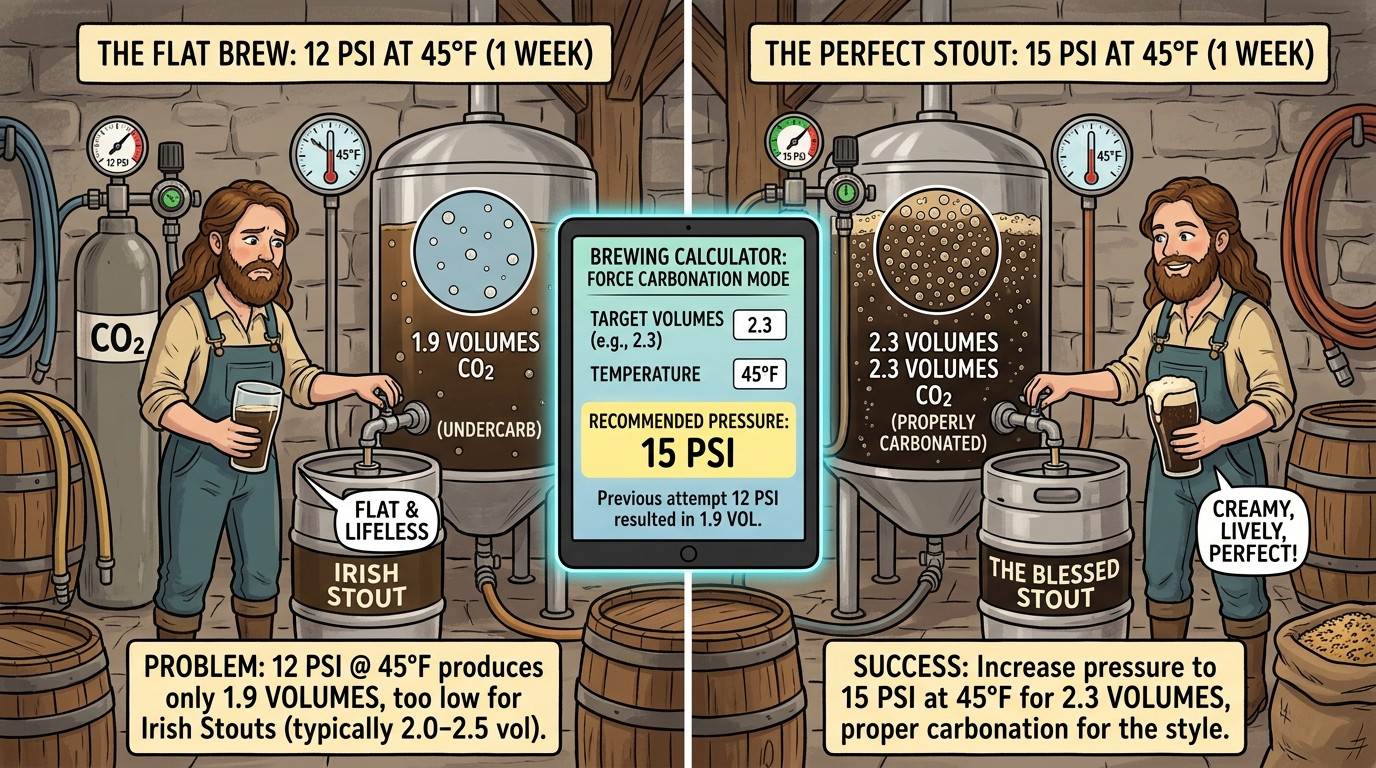
A brewer made an Irish stout and force-carbonated it at 12 PSI for one week at 45°F. When poured, the beer was flat and lifeless. The problem: at 45°F and 12 PSI, the beer only reached 1.9 volumes CO2, which is too low for most beer styles. Irish stouts typically have 2.0-2.5 volumes CO2. The brewing calculator’s force carbonation mode would have shown that 12 PSI at 45°F produces only 1.9 volumes, and recommended 15 PSI for 2.3 volumes—proper carbonation for the style.
Scenario 6: The High-Gravity Barleywine Challenge
A brewer wanted to brew a barleywine with OG 1.100 and expected 10% ABV with 75% attenuation (FG 1.025). However, high-gravity worts are more difficult to ferment, and the yeast only achieved 65% attenuation (FG 1.035), resulting in 8.5% ABV and a very sweet, cloying beer. The brewing calculator’s ABV mode would have shown that 1.100 to 1.035 is only 8.5% ABV, alerting the brewer to the problem. For high-gravity beers, the alternative ABV formula provides more accurate results: ABV = (76.08 × (OG – FG) / (1.775 – OG)) × (FG / 0.794).
Scenario 7: The Sour Beer Carbonation Problem
A brewer made a sour beer using mixed fermentation with Brettanomyces and bacteria. After 18 months of aging, the beer was ready to bottle, but the brewer wasn’t sure how much priming sugar to use because Brett can slowly ferment complex sugars over time. The brewer used standard priming sugar calculations and bottled with 4 oz corn sugar for 5 gallons. Six months later, the bottles were over-carbonated and gushing because Brett continued to ferment dextrins, adding another 0.5 volumes CO2. The brewing calculator’s carbonation mode includes a note about Brett and sour beers, recommending reduced priming sugar (20-30% less) to account for continued fermentation.
Scenario 8: The Recipe Scaling Challenge
A brewer had a successful 5-gallon IPA recipe and wanted to scale it up to 10 gallons for a homebrew club event. The brewer doubled all ingredients, including hops, but didn’t recalculate IBU. The problem: hop utilization changes with batch size and boil volume. The original recipe had 70 IBU in 5 gallons, but the scaled recipe only achieved 60 IBU in 10 gallons because of lower utilization in the larger boil. The brewing calculator’s IBU mode would have recalculated IBU for the 10-gallon batch, showing that more hops were needed to maintain 70 IBU.
Common Brewing Calculation Mistakes
The errors brewers make with brewing calculations cluster around a few predictable points. Understanding why they happen—and how the brewing calculator prevents them—is the key to consistent, high-quality beer.
Mistake 1: Not Accounting for Temperature in Hydrometer Readings
Hydrometers are calibrated at a specific temperature (usually 60°F or 68°F). If you take a reading at a different temperature, the reading will be inaccurate. Many brewers don’t realize this and use uncorrected readings in their calculations. For example, a wort at 120°F will read 0.005 lower than actual gravity. The brewing calculator includes temperature correction for hydrometer readings, ensuring accurate OG and FG measurements.
Mistake 2: Using the Wrong IBU Formula for the Beer Style
Some brewers use the Tinseth formula for all beers, but it may not be accurate for very high-gravity beers or beers with large late-hop additions. The Rager formula may give more accurate results in these cases. The brewing calculator uses Tinseth as the default but provides guidance on when to use alternative formulas for specific beer styles and brewing conditions.
Mistake 3: Over-Priming Bottles
One of the most dangerous mistakes is adding too much priming sugar, which can cause bottles to explode. This often happens when brewers don’t account for residual CO2 or mismeasure the batch volume. The brewing calculator’s carbonation mode accounts for residual CO2 based on beer temperature and provides exact priming sugar amounts for safe bottle conditioning.
Mistake 4: Ignoring Mash Efficiency in Gravity Calculations
Many brewers calculate expected OG based on 100% extraction efficiency, but real-world efficiency is typically 70-80%. This leads to lower-than-expected OG and frustration when the beer doesn’t match the recipe. The brewing calculator includes mash efficiency calculations, allowing brewers to adjust grain bills based on their actual efficiency.
Mistake 5: Not Adjusting IBU Calculations for Hop Age and Storage
Hops lose alpha acid potency over time, especially if not stored properly. Brewers often use the alpha acid percentage printed on the package without considering that the hops may have degraded. The brewing calculator includes hop storage index (HSI) calculations to estimate alpha acid loss over time, allowing brewers to adjust hop amounts for accurate IBU.
Mistake 6: Forgetting to Account for Trub Loss in Volume Calculations
Many brewers calculate priming sugar based on the total batch volume, but some beer is lost to trub (sediment) in the fermenter. This results in over-carbonation in the bottles. The brewing calculator allows brewers to input actual bottling volume (not total batch volume) for accurate carbonation calculations.
Mistake 7: Using Refractometer Readings After Fermentation Without Correction
Refractometers are excellent for measuring OG, but alcohol interferes with the reading after fermentation begins. Many brewers don’t realize this and use uncorrected refractometer readings to determine FG. The brewing calculator includes refractometer correction formulas, converting post-fermentation Brix readings to accurate specific gravity values.
💡 Rule of Thumb: Always use the brewing calculator with accurate hydrometer or refractometer readings, account for temperature corrections, adjust for hop age and storage, measure actual bottling volume (not total batch volume), and verify calculations with taste and experience. These habits prevent the errors that cause inconsistent batches, bottle bombs, and disappointing beers.
Expert Perspectives on Brewing Accuracy
The brewing professionals who work with brewing calculations daily share consistent advice about what separates great beer from mediocre beer—and how the brewing calculator helps achieve consistency.
“Accurate brewing calculations are the foundation of consistent beer quality. I’ve seen too many homebrewers struggle with inconsistent results because they don’t take the time to understand the math behind brewing. Once you master ABV, IBU, and carbonation calculations, you’ll have much more control over your beer and can troubleshoot problems more effectively.”
“The biggest mistake I see homebrewers make is not understanding the difference between IBU and perceived bitterness. A beer with 50 IBU can taste very different depending on the malt backbone, yeast character, and water chemistry. Use IBU calculations as a starting point, but always taste your beer and adjust recipes based on your preferences, not just the numbers.”
“Carbonation is one of the most overlooked aspects of homebrewing, but it has a huge impact on beer quality. I always tell brewers to use a carbonation calculator and keep detailed records of their carbonation levels. Over time, you’ll learn what carbonation levels work best for each style, and you’ll avoid the frustration of flat or over-carbonated beer.”
“Gravity measurements are your window into what’s happening during fermentation. Don’t just take OG and FG readings—track gravity throughout fermentation to understand your yeast’s behavior. This data is invaluable for troubleshooting and improving your brewing process. A brewing calculator helps you interpret this data and make informed decisions.”
Frequently Asked Questions About the Brewing Calculator
These questions come from homebrewers, craft brewers, and brewing students who use the brewing calculator in their daily brewing.
The key to accuracy is taking precise gravity readings with a calibrated hydrometer or refractometer at the correct temperature. The brewing calculator includes temperature correction for hydrometer readings and refractometer correction for post-fermentation readings.
The differences are usually within 5-10 IBU. The best approach is to pick one formula, use it consistently, and adjust your recipes based on your taste preferences rather than trying to match a target IBU exactly. The brewing calculator uses Tinseth as the default but provides guidance on when to use alternative formulas.
Most beers finish within 0.005-0.010 of the predicted FG based on yeast attenuation. If your FG is higher than expected, the fermentation may be stuck, and you may need to rouse the yeast, raise the temperature, or add more yeast. The brewing calculator helps you track attenuation and predict FG based on yeast strain specifications.
Many brewing apps and websites include refractometer correction tools. For the most accurate FG readings, many brewers prefer to use a hydrometer, but refractometers are faster and require less sample volume. The brewing calculator includes refractometer correction formulas for accurate post-fermentation readings.
As a general guideline, for a 5-gallon batch at 70°F targeting 2.4 volumes CO2 (typical for American ales), you’ll need approximately 4 oz of corn sugar or 3.7 oz of table sugar. Always measure priming sugar with a kitchen scale for accuracy, and dissolve it in 2 cups of boiling water before adding to your bottling bucket.
Real attenuation is usually 5-10% lower than apparent attenuation. Most homebrewers use apparent attenuation because it’s easier to calculate and provides consistent results for recipe formulation and yeast selection. The brewing calculator uses apparent attenuation for all calculations.
For quick estimates, you can use the rule of thumb that 1°P ≈ 4 gravity points (e.g., 12°P ≈ 1.048). Many brewing software packages and apps include built-in converters, but the brewing calculator provides instant, accurate conversions without additional software.
Use the brewing calculator’s carbonation mode to ensure you’re using the correct amount of priming sugar, confirm fermentation is complete with stable gravity readings, and maintain good sanitation practices. If you suspect an infection, look for off-flavors, excessive sediment, or gushing bottles.
For example, if you use 10 lbs of pale malt (36 points/lb potential) and collect 6 gallons of 1.050 wort (50 points), your efficiency = (50 × 6) / (36 × 10) = 83%. Track your efficiency over several batches to establish your typical range and adjust recipes accordingly.
IBU calculations don’t apply to wine and mead (unless you’re making hopped mead). Carbonation calculations work for sparkling wines and carbonated meads, though target carbonation levels may differ. Gravity conversions work the same way across all fermented beverages. The brewing calculator can be used for any fermented beverage with appropriate adjustments.
Brewing Best Practices
These practices separate great beer from mediocre beer. Follow them alongside the brewing calculator for consistent, high-quality results.
Before Brewing
During Brewing
After Brewing
Trusted Reference Resources
These are authoritative references for brewing calculations and brewing science that complement the brewing calculator.
How to Brew by John Palmer — howtobrew.com — The definitive guide to homebrewing, including detailed explanations of brewing calculations, mash efficiency, and recipe formulation.
Brewing Classic Styles by Jamil Zainasheff — brewingclassicstyles.com — 80 award-winning recipes with detailed calculations and brewing techniques for each BJCP style.
Brewers Association — brewersassociation.org — Resources for craft brewers, including brewing science articles, style guidelines, and brewing calculations.
BJCP Style Guidelines — bjcp.org — Beer Judge Certification Program style guidelines with OG, FG, IBU, and ABV ranges for each beer style.
American Homebrewers Association — homebrewersassociation.org — Resources for homebrewers, including brewing science articles, recipes, and brewing calculations.
On our platform, related calculation tools that complement the brewing calculator include: alcohol dilution calculator, brix calculator, specific gravity calculator, proof calculator, ethanol dilution calculator, percent concentration calculator, ABV calculator, PPM calculator, solution dilution calculator, and dilution calculator (all-in-one).
Leave a Review
Used this brewing calculator in your home brewery or craft brewery? Share your experience below. Your review helps other brewers decide if this brewing calculator fits their brewing workflow. Every review is stored locally on your device and appears instantly.
📝 Share Your Experience
Final Thoughts on the Brewing Calculator
Brewing calculations are one of those brewing skills that seems straightforward until ABV, IBU, gravity conversions, and carbonation calculations all meet in a single recipe. The arithmetic is, in principle, simple—ABV = (OG – FG) × 131.25—but a single error in gravity reading, hop utilization, or priming sugar can produce a beer that misses the mark, or worse, a bottle bomb that causes injury. The brewing calculator exists to remove that arithmetic risk, handling every calculation internally and showing each step so the result can be verified, learned, and documented.
What separates great beer from mediocre beer is discipline, not genius. Using accurate hydrometer readings with the brewing calculator, accounting for temperature corrections, adjusting for hop age and storage, measuring actual bottling volume, and tasting and adjusting based on experience: these are the habits that catch the errors the human brain makes under time pressure, distraction, and fatigue. The brewing calculator does the maths perfectly every time, but it cannot taste your beer, observe fermentation, or prevent contamination—that remains the brewer’s responsibility.
The framework is short: calculate with the brewing calculator, measure accurately, taste critically, and adjust based on experience. That sequence gives great beer every time. From homebrewing in your garage to craft brewing in a commercial brewery, accurate brewing calculations are the foundation of consistent, high-quality beer, and getting it right with the brewing calculator is one of the most important skills in brewing.
Keep this brewing calculator handy as your starting point for every recipe formulation, and use the related dilution and concentration tools in the sidebar whenever you need to plan or verify a calculation before brewing.
🔒 Privacy Guarantee: Every calculation on this brewing calculator page runs entirely within your browser. No data—gravity readings, hop additions, priming sugar amounts, or any other inputs—is sent to any server, stored, or shared. Your calculations are completely private.