
🧪 Pool Chemistry Calculator
Calculate calcium hardness, cyanuric acid, TDS & water balance (LSI) for perfect pool chemistry
⚠️ Pool Chemistry Safety Note
MAINTAIN PROPER WATER BALANCE. Imbalanced water can cause scaling, corrosion, and swimmer discomfort. Always test water chemistry regularly and maintain proper levels. Calcium hardness, cyanuric acid, and TDS affect water balance and equipment longevity. Follow manufacturer recommendations and local regulations for pool chemistry management.
Calculation History
💡 You Might Also Like
Pool Chemistry Calculator: Calcium Hardness, Cyanuric Acid, TDS & Water Balance Calculator
A pool chemistry calculator is an essential tool that helps pool owners and professionals accurately calculate calcium hardness adjustments, cyanuric acid levels, total dissolved solids (TDS) management, and water balance using the Langelier Saturation Index (LSI). Proper water chemistry prevents scaling, corrosion, and equipment damage while ensuring swimmer comfort. Whether you’re adjusting calcium hardness to 200-400 ppm, managing cyanuric acid at 30-50 ppm for outdoor pools, reducing high TDS through water replacement, or calculating LSI for balanced water, this pool chemistry calculator provides accurate calculations with step-by-step explanations for optimal pool chemistry management.
MAINTAIN PROPER WATER BALANCE. Imbalanced water can cause scaling, corrosion, and swimmer discomfort. Calcium hardness below 200 ppm causes corrosive water that damages equipment. Calcium hardness above 400 ppm causes scaling and cloudy water. Cyanuric acid above 100 ppm reduces chlorine effectiveness. High TDS (>1500 ppm above source water) causes cloudy water and reduced chemical effectiveness. Always test water chemistry regularly and maintain proper levels. Follow manufacturer recommendations and local regulations for pool chemistry management.
📋 Table of Contents
▼What a Pool Chemistry Calculator Does
A pool chemistry calculator is a specialized tool that performs essential calculations for advanced pool water chemistry, including calcium hardness adjustments, cyanuric acid (CYA) management, total dissolved solids (TDS) reduction, and water balance calculations using the Langelier Saturation Index (LSI). According to the Centers for Disease Control and Prevention (CDC), proper water chemistry is critical for preventing scaling, corrosion, equipment damage, and ensuring swimmer comfort and safety.
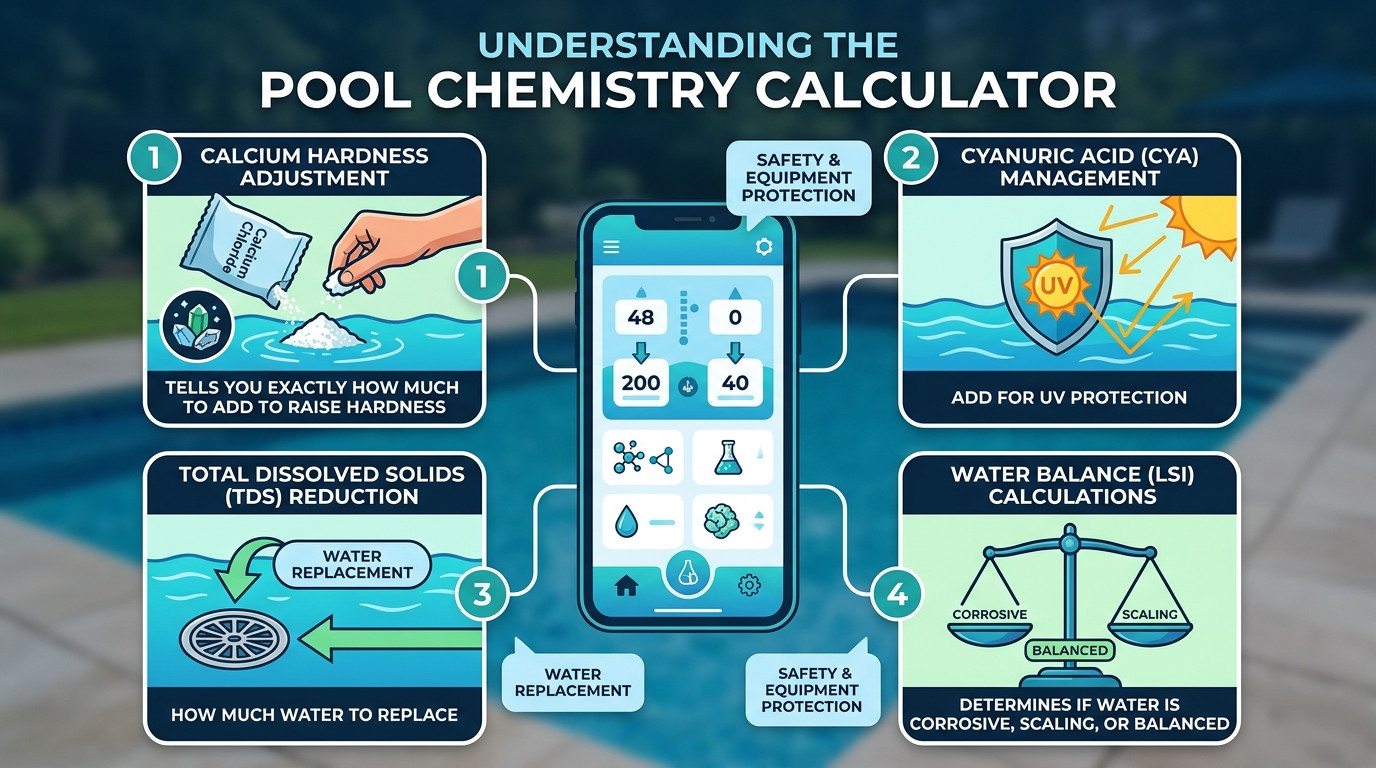
A pool chemistry calculator tells you exactly how much calcium chloride to add to raise hardness, how much cyanuric acid to add for UV protection, how much water to replace to reduce TDS, and whether your water is balanced, corrosive, or scaling using LSI calculations. Unlike basic pool chemical calculators, a pool chemistry calculator focuses on long-term water quality management and equipment protection. Every pool owner, commercial pool operator, and water treatment professional who wants to protect their investment and ensure optimal water quality relies on these calculations, and the pool chemistry calculator exists to make them fast, accurate, and educational.
The reason pool chemistry calculations trip people up is not the arithmetic itself but the complex interactions between multiple water parameters. Calcium hardness affects scaling potential. Cyanuric acid affects chlorine effectiveness. TDS affects chemical effectiveness and water clarity. LSI considers all these factors together to determine water balance. The pool chemistry calculator handles all of these scenarios internally so you can focus on enjoying your pool rather than doing complex water chemistry calculations.
This pool chemistry calculator handles the four most important pool chemistry calculation tasks in one place: calcium hardness adjustment (calcium chloride dosing), cyanuric acid management (stabilizer dosing), TDS reduction (water replacement calculations), and water balance analysis (Langelier Saturation Index). Each mode shows the answer and every step of the working, so you can verify the reasoning, learn the science, or document the calculation for your pool maintenance records.
Whether you are a homeowner dealing with scaling issues, a commercial pool operator managing water quality for multiple facilities, a water treatment professional servicing aquatic centers, or a pool service technician troubleshooting water balance problems, the pool chemistry calculator gives you the exact calculations every time—no guesswork, no scaling, no corrosion, no imbalanced water.
How Pool Chemistry Calculations Work
Every pool chemistry calculation comes down to one idea: maintaining proper water balance to prevent scaling, corrosion, and equipment damage while ensuring swimmer comfort. From that single principle, a handful of formulas cover almost every pool chemistry calculation task. The pool chemistry calculator exists to handle those formulas reliably and transparently, because in practice the “arithmetic” is layered with complex water chemistry interactions, unit conversions, and safety considerations—and any one of them, applied wrongly, can damage equipment or harm swimmers.
Understanding Calcium Hardness
Calcium hardness measures the amount of dissolved calcium in pool water. Ideal range is 200-400 ppm. Low calcium hardness (<200 ppm) causes corrosive water that etches plaster, corrodes metal equipment, and causes swimmer discomfort. High calcium hardness (>400 ppm) causes scaling, cloudy water, and clogged filters. The pool chemistry calculator uses the formula: (Volume × ppm increase) / (concentration × 10,000) = pounds needed. For example, to raise calcium hardness by 100 ppm in a 10,000-gallon pool using 77% calcium chloride, you need (10,000 × 100) / (0.77 × 10,000) = 1.30 pounds.
ppm increase = desired increase in parts per million
concentration = chemical concentration (e.g., 0.77 for 77% calcium chloride)
10,000 = conversion factor for gallons to pounds
Cyanuric Acid (CYA): UV Stabilizer
Cyanuric acid (CYA) stabilizes chlorine against UV degradation in outdoor pools. Ideal range is 30-50 ppm for outdoor pools, 0-10 ppm for indoor pools. Low CYA causes rapid chlorine loss to sunlight. High CYA (>100 ppm) reduces chlorine effectiveness, requiring higher chlorine levels for sanitization. The pool chemistry calculator uses the same formula as calcium hardness but with different concentrations: granular stabilizer (99%) or liquid stabilizer (40%).
Total Dissolved Solids (TDS): Water Replacement
TDS measures all dissolved substances in pool water. Ideal TDS is no more than 1500 ppm above source water TDS. High TDS causes cloudy water, reduced chemical effectiveness, and scaling. TDS can only be reduced by draining and refilling with fresh water. The pool chemistry calculator uses the formula: Volume to replace = Pool Volume × (Current TDS – Target TDS) / (Current TDS – Source TDS). For example, to reduce TDS from 2500 ppm to 1500 ppm in a 10,000-gallon pool with source water at 500 ppm, you need to replace 10,000 × (2500-1500) / (2500-500) = 5,000 gallons (50% of pool volume).
Langelier Saturation Index (LSI): Water Balance
The Langelier Saturation Index (LSI) determines whether water is balanced, corrosive, or scaling. LSI considers pH, temperature, calcium hardness, total alkalinity, cyanuric acid, and TDS. Ideal LSI is -0.3 to +0.3 (balanced). LSI < -0.3 indicates corrosive water. LSI > +0.3 indicates scaling water. The pool chemistry calculator uses the LSI formula: LSI = pH + TF + CF + AF + TDSF – 12.1, where TF is temperature factor, CF is calcium factor, AF is alkalinity factor, and TDSF is TDS factor.
Quick Reference Values for the Pool Chemistry Calculator
Remember: The pool chemistry calculator provides accurate calculations, but pool chemistry is complex and dynamic. Test water chemistry regularly (calcium hardness, CYA, TDS, LSI parameters), adjust based on test results, and follow manufacturer instructions. Use the calculator as a starting point, then fine-tune based on actual test results and pool conditions.

Real Scenarios Where Pool Chemistry Mattered
These scenarios reflect real pool maintenance situations where water chemistry calculation errors made a tangible difference to equipment protection and water quality. Each scenario shows how the pool chemistry calculator would have prevented the error.
Scenario 1: The Corrosive Water Disaster
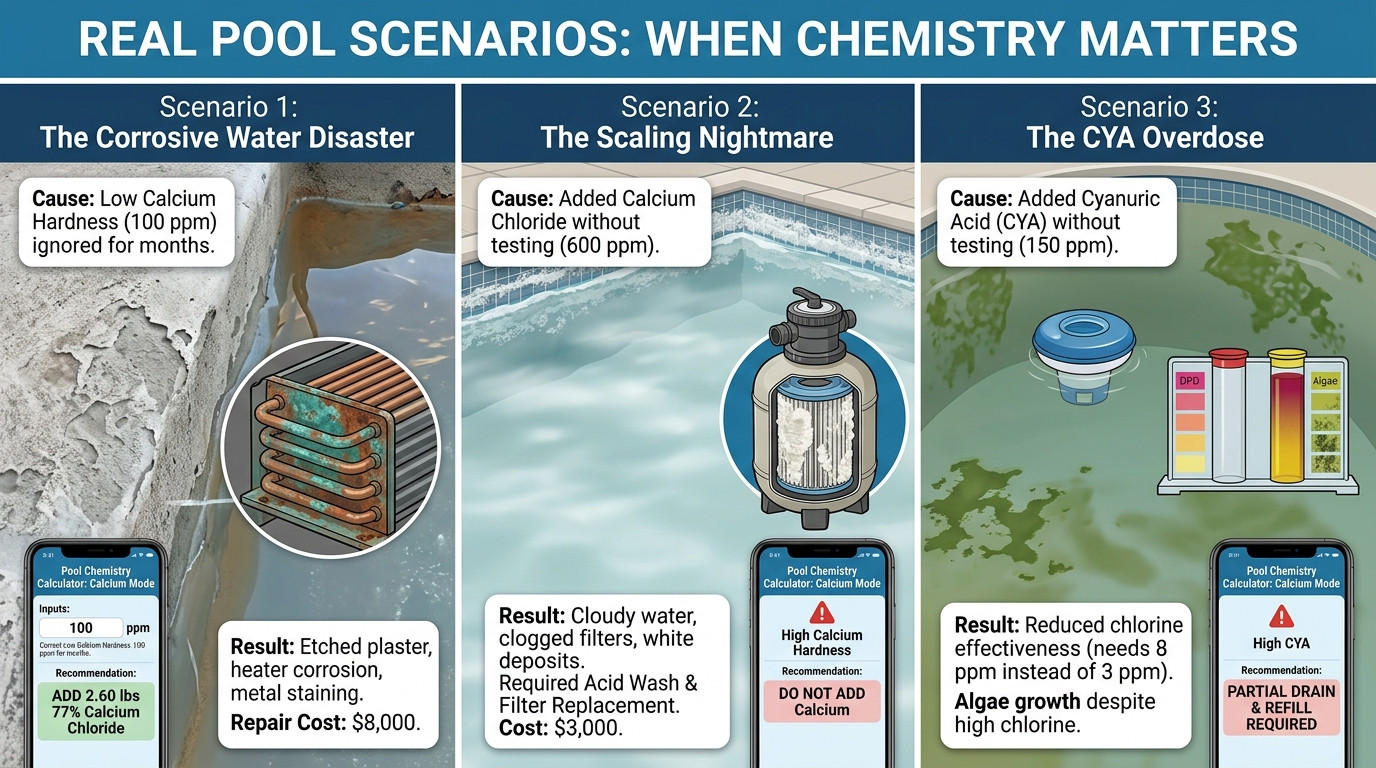
A pool owner ignored calcium hardness testing for months. The calcium hardness dropped to 100 ppm (corrosive range). The corrosive water etched the pool plaster, corroded the heater heat exchanger, and caused metal staining. The repair cost was $8,000. The pool chemistry calculator’s calcium hardness mode would have identified the low hardness and calculated 2.60 pounds of 77% calcium chloride to raise it to 300 ppm, preventing the corrosion.
Scenario 2: The Scaling Nightmare
A pool owner added calcium chloride without testing, raising calcium hardness to 600 ppm (scaling range). The water became cloudy with calcium scale, clogging filters and leaving white deposits on pool surfaces. The pool required acid washing and filter replacement, costing $3,000. The pool chemistry calculator would have shown that no additional calcium was needed, preventing the scaling.
Scenario 3: The CYA Overdose
A pool owner added cyanuric acid without testing, raising CYA to 150 ppm. The high CYA reduced chlorine effectiveness, requiring 8 ppm chlorine instead of 3 ppm for proper sanitization. The pool developed algae despite high chlorine levels. The pool chemistry calculator’s CYA mode would have shown that no additional CYA was needed, preventing the overdose.
Scenario 4: The High TDS Problem
A commercial pool had TDS at 3500 ppm (2000 ppm above source water). The high TDS caused cloudy water, reduced chemical effectiveness, and scaling. The pool required partial drain and refill, but without calculation, they only replaced 20% of water instead of the needed 60%. The TDS remained high, requiring another drain and refill, doubling the cost. The pool chemistry calculator’s TDS mode would have calculated exactly 60% water replacement needed, saving time and money.
Scenario 5: The LSI Imbalance
A pool had LSI of -0.8 (corrosive) but the owner didn’t test LSI. The corrosive water damaged pool equipment and caused swimmer eye irritation. After testing, the pool chemistry calculator’s LSI mode identified the imbalance and showed that raising calcium hardness from 150 ppm to 300 ppm would bring LSI to -0.2 (balanced), preventing further damage.
Scenario 6: The Calcium Chloride Flakes Confusion
A pool owner used 94% calcium chloride flakes but calculated as if using 77% calcium chloride. The result was 22% less calcium than needed, leaving hardness at 180 ppm (corrosive). The pool chemistry calculator provides options for both 77% and 94% calcium chloride, ensuring accurate dosing regardless of product type.
Scenario 7: The Liquid vs. Granular CYA Mistake
A pool owner used liquid stabilizer (40% CYA) but calculated as if using granular stabilizer (99% CYA). The result was 60% less CYA than needed, leaving CYA at 15 ppm instead of 40 ppm. Chlorine degraded rapidly in sunlight. The pool chemistry calculator provides options for both granular and liquid CYA, ensuring accurate dosing.
Scenario 8: The TDS Source Water Error
A pool owner tried to reduce TDS from 2500 ppm to 1500 ppm but used 1000 ppm as source water TDS instead of the actual 500 ppm. The calculation showed 40% water replacement instead of the needed 60%. The TDS remained high after the drain and refill. The pool chemistry calculator requires source water TDS input, ensuring accurate water replacement calculations.
Common Pool Chemistry Mistakes
The errors pool owners and operators make with pool chemistry cluster around a few predictable points. Understanding why they happen—and how the pool chemistry calculator prevents them—is the key to protecting equipment and ensuring optimal water quality.
Mistake 1: Ignoring Calcium Hardness
Many pool owners never test calcium hardness, leading to corrosive or scaling water. Always test calcium hardness and maintain 200-400 ppm. The pool chemistry calculator’s calcium mode helps you maintain proper hardness levels.
Mistake 2: Adding Calcium Without Testing
Adding calcium chloride without testing current levels leads to overdosing and scaling. Always test before adding. The pool chemistry calculator requires current calcium level as input, ensuring accurate dosing.
Mistake 3: Ignoring Cyanuric Acid
Many pool owners never test CYA, leading to rapid chlorine loss (low CYA) or reduced chlorine effectiveness (high CYA). Always test CYA and maintain 30-50 ppm for outdoor pools. The pool chemistry calculator’s CYA mode helps you maintain proper CYA levels.
Mistake 4: Using Wrong CYA Concentration
Different CYA products have different concentrations. Using the wrong concentration in calculations leads to incorrect dosing. The pool chemistry calculator provides options for granular (99%) and liquid (40%) CYA.
Mistake 5: Ignoring TDS
Many pool owners never test TDS, leading to cloudy water and reduced chemical effectiveness. Always test TDS and maintain no more than 1500 ppm above source water. The pool chemistry calculator’s TDS mode helps you calculate water replacement needed.
Mistake 6: Not Testing Source Water TDS
TDS reduction calculations require source water TDS. Using wrong source water TDS leads to incorrect water replacement calculations. The pool chemistry calculator requires source water TDS input.
Mistake 7: Ignoring LSI
Many pool owners never calculate LSI, leading to corrosive or scaling water without knowing it. Always calculate LSI and maintain -0.3 to +0.3. The pool chemistry calculator’s LSI mode helps you determine water balance.
💡 Rule of Thumb: Always test calcium hardness, CYA, TDS, and LSI parameters regularly. Use the pool chemistry calculator for precise calculations, maintain proper levels, and follow manufacturer instructions. These habits prevent scaling, corrosion, and equipment damage.
Expert Perspectives on Pool Chemistry
The water chemistry professionals who work with pool chemistry daily share consistent advice about what separates balanced water from corrosive or scaling water—and how the pool chemistry calculator helps achieve optimal water quality.
“The biggest mistake I see is pool owners ignoring calcium hardness. Low calcium causes corrosive water that destroys equipment. The pool chemistry calculator’s calcium mode helps maintain proper hardness and prevents thousands of dollars in equipment damage.”
“CYA management is critical for outdoor pools. Too little CYA and chlorine degrades in sunlight. Too much CYA and chlorine becomes ineffective. The pool chemistry calculator’s CYA mode helps maintain proper CYA levels and ensures effective sanitization.”
“High TDS is the silent killer of pool water quality. It causes cloudy water and reduces chemical effectiveness. The pool chemistry calculator’s TDS mode calculates exactly how much water to replace, saving time and money on drain and refill operations.”
“LSI is the ultimate water balance indicator. It considers all water chemistry parameters together. The pool chemistry calculator’s LSI mode helps identify corrosive or scaling water before it damages equipment or causes swimmer discomfort.”
Frequently Asked Questions About the Pool Chemistry Calculator
These questions come from pool owners and operators who use the pool chemistry calculator in their daily pool maintenance routine.
For example, to raise calcium hardness by 100 ppm in a 10,000-gallon pool using 77% calcium chloride, the calculator determines you need exactly 1.30 pounds. Always verify with test results and adjust as needed.
The pool chemistry calculator helps you calculate adjustments based on test results. Test more frequently after adding calcium or after heavy rain.
The pool chemistry calculator’s CYA mode helps you maintain proper CYA levels based on your pool volume and current CYA level.
The pool chemistry calculator’s TDS mode calculates exactly how much water to replace based on these parameters. For example, to reduce TDS from 2500 ppm to 1500 ppm with source water at 500 ppm, you need to replace 50% of pool water.
The pool chemistry calculator’s LSI mode considers pH, temperature, calcium hardness, total alkalinity, cyanuric acid, and TDS to calculate LSI and determine water balance.
The pool chemistry calculator’s LSI mode identifies corrosive water and helps you adjust parameters to achieve balanced water.
The pool chemistry calculator’s LSI mode identifies scaling water and helps you adjust parameters to achieve balanced water.
The pool chemistry calculator’s TDS mode requires source water TDS input to calculate accurate water replacement amounts.
The pool chemistry calculator provides options for both 77% and 94% calcium chloride, calculating the correct amount for each concentration.
Always follow manufacturer recommendations for your specific pool type and equipment. The calculator provides accurate chemistry calculations for any pool type.
Pool Chemistry Best Practices
These practices separate balanced water from corrosive or scaling water. Follow them alongside the pool chemistry calculator for optimal pool chemistry.
Before Adjusting Water Chemistry
During Water Chemistry Adjustments
After Water Chemistry Adjustments
Trusted Reference Resources
These are authoritative references for pool chemistry and water quality management that complement the pool chemistry calculator.
CDC Healthy Swimming — cdc.gov/healthywater/swimming — Comprehensive pool safety guidelines, water chemistry recommendations, and water quality standards from the Centers for Disease Control and Prevention.
Association of Pool & Spa Professionals (APSP) — apsp.org — Industry standards, certification programs, and best practices for pool chemistry management and water quality.
National Swimming Pool Foundation (NSPF) — nspf.org — Certified Pool Operator (CPO) training, water chemistry education, and water quality management resources.
Environmental Protection Agency (EPA) — epa.gov/pesticides — EPA regulations for pool chemicals, water quality guidelines, and environmental protection standards.
Pool & Hot Tub Alliance (PHTA) — phta.org — Industry association for pool and hot tub professionals, offering education, certification, and best practices for water chemistry management.
On our platform, related calculation tools that complement the pool chemistry calculator include: pool chemical calculator, bleach dilution calculator, sodium hypochlorite calculator, pH calculator, PPM calculator, solution dilution calculator, percent concentration calculator, dilution factor calculator, mixing ratio calculator, and dilution calculator (all-in-one).
Leave a Review
Used this pool chemistry calculator for your pool maintenance? Share your experience below. Your review helps other pool owners and operators decide if this pool chemistry calculator fits their pool maintenance needs. Every review is stored locally on your device and appears instantly.
📝 Share Your Experience
Final Thoughts on the Pool Chemistry Calculator
Pool chemistry calculations are one of those pool maintenance skills that seems straightforward until calcium hardness, cyanuric acid, TDS, and LSI all meet in a single water chemistry analysis. The arithmetic is, in principle, simple—Volume × ppm increase / concentration—but a single error in volume, concentration, or target level can damage equipment or harm swimmers. The pool chemistry calculator exists to remove that arithmetic risk, handling every calculation internally and showing each step so the result can be verified, learned, and documented.
What separates balanced water from corrosive or scaling water is precision, not guesswork. Using the pool chemistry calculator for precise chemistry measurements, testing before making adjustments, maintaining proper levels, and following manufacturer instructions: these are the habits that prevent scaling, corrosion, and equipment damage. The pool chemistry calculator does the maths perfectly every time, but it cannot test your water, add chemicals, or run your pump—that remains the pool owner’s responsibility.
The framework is short: test water chemistry, calculate with the pool chemistry calculator, add chemicals gradually, run pump, retest, and document. That sequence gives balanced, safe water every time. From backyard pools and commercial aquatic facilities to water parks and hot tubs, accurate pool chemistry calculations are the foundation of equipment protection and water quality, and getting it right with the pool chemistry calculator is one of the most important skills in pool maintenance.
Keep this pool chemistry calculator handy as your starting point for every pool chemistry task, and use the related dilution and concentration tools in the sidebar whenever you need to plan or verify a calculation before treating your pool.
🔒 Privacy Guarantee: Every calculation on this pool chemistry calculator page runs entirely within your browser. No data—pool volumes, chemical amounts, test results, or any other inputs—is sent to any server, stored, or shared. Your calculations are completely private.
Pingback: Pool Salt Calculator | Calculate Salt for Your Pool Instantly
Pingback: Pool Alkalinity Calculator | Calculate Alkalinity Adjustment
Pingback: Cyanuric Acid Calculator | Calculate CYA Levels Instantly
Pingback: Pool Calcium Hardness Calculator | Calculate Calcium Adjustment
Pingback: Spa Chemical Calculator | Calculate Spa Chemicals Instantly